
Within the complex world of airports, each area has a clear function to ensure the safety and efficiency of air traffic. One of the most important is the maneuvering area, a strictly regulated space that is essential for aircraft operations.
From Viarium, we explain in detail what it is, how it is structured, and why it is vital for airport management.
What is the maneuvering area of an airport?
The maneuvering area is the part of the airport reserved exclusively for aircraft movement related to takeoffs, landings, and ground maneuvers, excluding parking areas or aprons..
Therefore, as far as passengers are concerned, does not include terminals or areas where passengers board or disembark, but rather those operational surfaces used by aircraft during critical phases of their operation.
According to the International Civil Aviation Organization (ICAO), the maneuvering area includes:
- Runways.
- Roller streets.
- Links between tracks and streets.
These areas require strict control by the control tower, as any interference may compromise operational safety.
What areas make up the maneuvering area?
The maneuvering area consists of:
- Runways: areas designated for takeoffs and landings.
- Taxiways: connect the runways with other areas of the airport.
- Intersections and access points: allow transit between runways and streets, or between different parts of the airport.
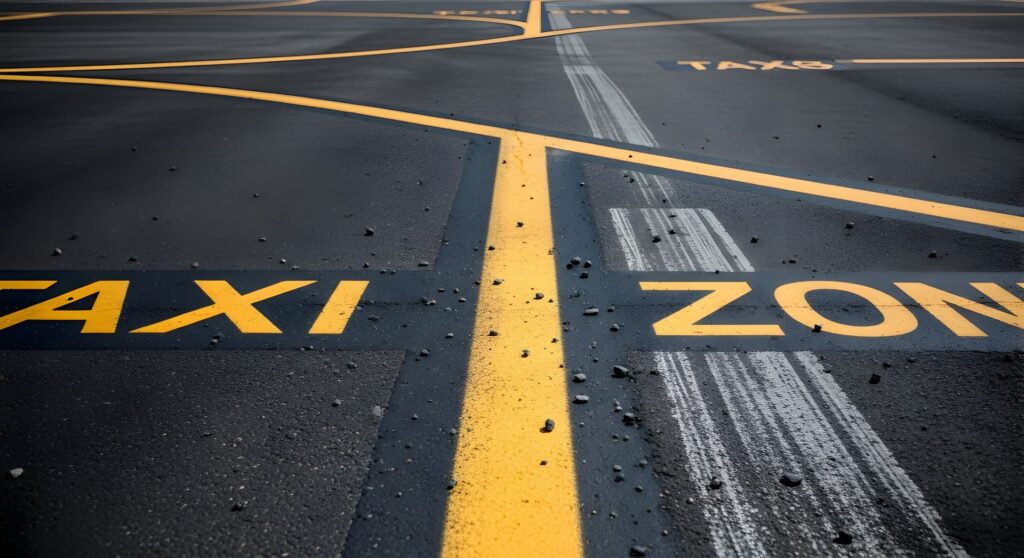
These areas are marked with horizontal signage, aeronautical lights, and specific communications to ensure their correct use.
Safety distance between aircraft in the maneuvering area
The distance between aircraft when using the maneuvering area is determined by international safety protocols. Different separation minima apply depending on the type of aircraft, visibility, and type of maneuver (taxiing, alignment, takeoff) and weather conditions.
The control tower is responsible for enforcing these distances, keeping each aircraft in its corresponding position until it is safe to proceed. Constant communication between the pilot and the tower is essential to prevent incidents.
How is priority determined in the maneuvering area?
Priorities in the maneuvering area are regulated by international aviation standards and by instructions from tower controllers. The aim is to maximize traffic flow without compromising safety.
Priority of maneuvers at an airport
Generally, the following have priority:
- Aircraft in the landing phase over those that are about to take off.
- Aircraft in distress take priority over all others.
- Aircraft taxiing over service vehicles (except in exceptional circumstances).
Priority of maneuvers in flight
In airspace or when approaching the maneuvering area, priorities are also defined according to conditions such as:
- Type of aircraft (ultralights, commercial, military).
- Visual or instrument flight rules.
- Sequence established by the controller.
These rules are set out in the Air Traffic Regulations and are essential for coordinating operations smoothly.
The importance of the maneuvering area at an airport
The maneuvering area is one of the most critical spaces for the safe operation of an airport. Its design, maintenance, and supervision have a direct impact on the efficiency of air operations.
Good control of the maneuvering area:
- Avoid collisions and incidents on the ground.
- Reduce delays due to congestion.
- Optimize the use of tracks and streets.
- Contributes to operational sustainability.
At Viarium, we are experts in design and airport planning, which is why we understand that excellence in airport infrastructure management begins with in-depth knowledge of key areas such as this. For this reason, we apply advanced technologies, international safety standards, and a comprehensive approach that guarantees efficient and safe air mobility.