
In the world of air transport, efficiency and safety in baggage handling are key aspects. For this reason, it is increasingly common to encounter the term BHS en el ámbito aeroportuario.
But, What is BHS? Exactly? Since VIARIUM, we delve deeper into the topic to provide you with the most accurate and up-to-date information available.
What is BHS?
The acronym BHS responds to Baggage Handling System, that is, baggage handling system. This comprehensive set of technologies, equipment, and processes is responsible for transport, sort, inspect, and distribute passenger baggage from the moment it is checked in until it is loaded onto the aircraft, and vice versa during arrivals.
Designed to minimize human error and increase operational efficiency, the BHS integrates with other airport systems, such as security systems (e.g., CT scanners), flight information systems, and airline logistics platforms.
In summary, when we ask ourselves what is BHS, we are referring to the logistical backbone that ensures that every suitcase arrives safely at its destination.
Benefits of BHS at airports
Implementing a robust, well-designed BHS system brings multiple benefits for airports, passengers, and airlines alike. Among the main benefits are:
- Reduction of human error: Automation significantly reduces the likelihood of baggage misdirection, loss, or delays in delivery.
- Greater operational efficiency: It allows thousands of bags to be processed per hour, optimizing check-in and boarding times.
- Integration with security systems: Includes automatic security checks such as X-rays without slowing down the logistics process.
- Real-time traceability: Thanks to barcode or RFID tag scanning, each piece of luggage can be accurately tracked.
- Improving the passenger experience: Shorter waiting times and fewer incidents increase overall passenger satisfaction.
- Space optimization: Modular designs allow for better use of space in congested terminals.
Thus, the BHS system not only represents a technological improvement, but also a strategic tool in the competitive airport industry.
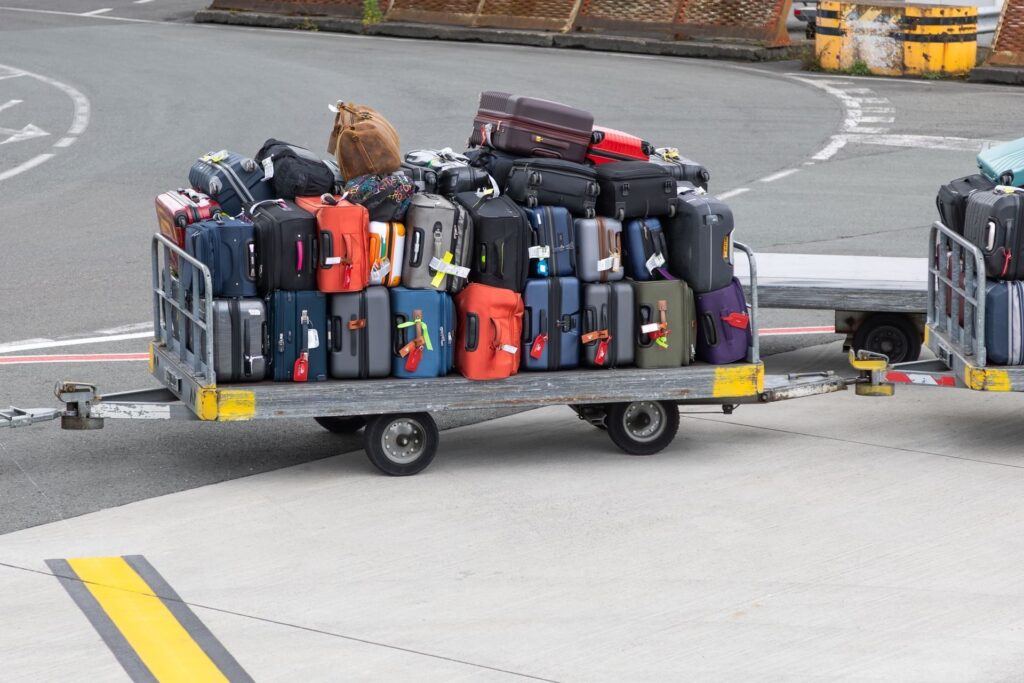
How the BHS system works
The BHS (Baggage Handling System) It functions as a precise mechanism between various technological components. Its operation can be divided into five main stages:
1. Baggage claim
When passengers check in their luggage, it enters the system via a conveyor belt that automatically reads the label.
2. Automatic classification
A series of sensors and optical readers identify the destination, class, and urgency of the baggage. This allows it to be sent to the correct channel within the system.
3. Safety inspection
Baggage passes through automatic security scanners (ETD or EDS), which detect possible prohibited items. If necessary, it is referred for a secondary manual inspection.
4. Temporary storage (if applicable)
In cases where aircraft loading has not yet begun, bags can be stored in special areas within the system, called Early Baggage Storage (EBS).
5. Transportation to the aircraft
Once loading is authorized, the system directs each piece of luggage to the cart or vehicle assigned to its flight.
The entire process is supervised by centralized control software, which constantly communicates with the airport and airline databases.
Origin of the BHS system
The concept of an automated baggage handling system was born in the mid-20th century, although its development began in the 1980s with the exponential growth of international air traffic.
As airports began to receive increasing volumes of passengers, it became clear that manual systems were not sustainable. The first BHSs were implemented in large hubs such as Frankfurt, Heathrow and Chicago O’Hare, where logistical needs already exceeded what human operators could handle.
Since then, the system has evolved to incorporate technologies such as:
- Radio frequency identification (RFID)
- Predictive software based on artificial intelligence
- Smart sensors for predictive maintenance
- Self-check-in and self bag-drop systems
Currently, the BHS system is considered critical infrastructure at any international airport.
Types of baggage handling
There are various BHS models and configurations, depending on the size of the airport, passenger flow, and local security regulations. The most common ones are described below:

1. Conventional systems
These are modular systems that combine conveyor belts, pushers, and scanners. They are widely used in medium-sized airports.
2. Individual Carrier Systems (ICS)
Each suitcase is transported separately on a tray, ensuring greater accuracy and safety in sorting.
3. Hybrid systems
They combine elements from previous systems with advanced solutions such as loading robots, thermal sensors, and 3D cameras.
4. Decentralized systems
At airports with multiple terminals, several interconnected BHS subsystems are installed, facilitating baggage handling between connecting flights.
Each of these models meets different operational needs and can be scaled as the airport grows.
Conclusion
The BHS systems not only enable efficient baggage handling, but also have a direct impact on the passenger experience, overall airport security, and airline profitability. From its origins to its most advanced versions, the Baggage Handling System represents the convergence of automation, logistics, and intelligent control.