
Aircraft braking systems, which are common in military settings and are also found at civilian airports, allow planes to be brought to a stop in critical situations by gradually absorbing energy.
A commercial airplane can land at speeds exceeding 200 km/h and weigh tens of metric tons. An Airbus A320, one of the most recognizable models to the general public, can weigh more than 60 metric tons upon landing, depending on its configuration. When something goes wrong and the plane fails to come to a stop on the runway, the challenge is not simply to “brake,” but to dissipate an enormous amount of energy in a matter of seconds without endangering people, the aircraft, or the infrastructure.
This is where an engineering solution comes into play that is little known to the general public but is crucial for certain airport operations: aircraft braking systems, also known as braking barriers or arresting systems.
Its purpose is clear: to stop an aircraft that has been unable to brake on its own and to reduce the risk of running off the runway, thereby protecting both the crew and the infrastructure.
“A braking barrier is a safety system designed to stop an aircraft that cannot come to a stop on the runway. It serves to reduce the risk of runway overrun and protect both the aircraft and people,” explains Paula Abilio, an engineer at Viarium.
It's not a rigid barrier—it's a smart way to absorb energy
Although the word “barrier” may bring to mind a wall or something that blocks an object abruptly, these systems operate in a much more precise manner. Their purpose is not to stop the aircraft abruptly, but to slow it down gradually and in a controlled manner.
The key lies in converting the energy of motion into deformation, friction, or controlled resistance, depending on the type of system installed. In other words, it’s not about bringing an airplane to a “sudden” stop, but rather providing a calculated response when the runway no longer offers sufficient space.
“What sets it apart is that it does not act as a rigid barrier, but rather as a system designed to absorb energy in a gradual and controlled manner.”, Abilio points out.
To understand the magnitude of the challenge, a simple comparison will suffice. A family car can weigh around 1.5 metric tons and travel on the highway at 120 km/h. A commercial airplane can weigh many times that much and land at speeds exceeding 200 km/h. The consequence is clear: the energy that must be dissipated does not increase linearly. In certain scenarios, it can be tens or even hundreds of times greater than that of a car.
That is why, when the runway runs out, the challenge is not simply to brake, but to bring the aircraft to a controlled stop within a limited space, without compromising the safety of the passengers, the aircraft’s structure, or the airport infrastructure itself.
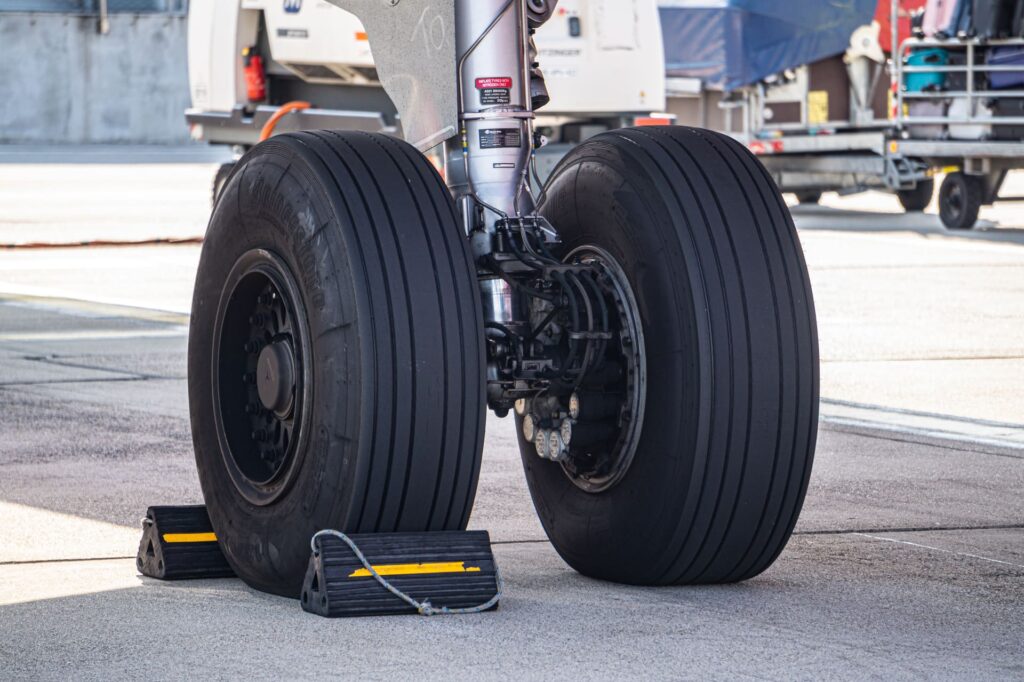
Unlike a car, which relies primarily on its brakes and the tires' contact with the road, an airplane has several systems to reduce its speed after landing, such as landing gear brakes, spoilers, and thrust reversers. But when those systems are not enough or the runway runs out, external braking systems act as an additional layer of safety.
Therefore, to properly design a braking system of this type, it is necessary to analyze the aircraft's mass, its approach speed, the type of landing gear, the available runway length, and the braking capacity required to bring it to a controlled stop.
Cables, nets, and flexible materials: different ways to stop an airplane
Even though we talk about “barriers,” not all of them work the same way or look the way you might imagine. Some use steel cables which the plane engages to transfer its energy to absorption systems located on the sides of the runway. Others use technical networks, capable of enveloping and retaining the aircraft in a controlled manner. There are also solutions based on deformable materials, which act as a surface designed to give way under the weight of the aircraft and gradually reduce its speed.
To put it simply: some solutions “grab” the plane, others “envelop” it, and still others cause it to move across a surface that deforms to slow it down. In all cases, the goal is the same: to turn a critical situation into a controlled stop.
Depending on the configuration, the system may include steel cables, nylon or polyester nets, folding posts, anchors, foundations, hydraulic or mechanical systems, and other energy-absorbing elements. Although these may seem like simple solutions in theory, all of these components must function as part of a single system designed to respond in a critical situation.
From aircraft carriers to land-based runways
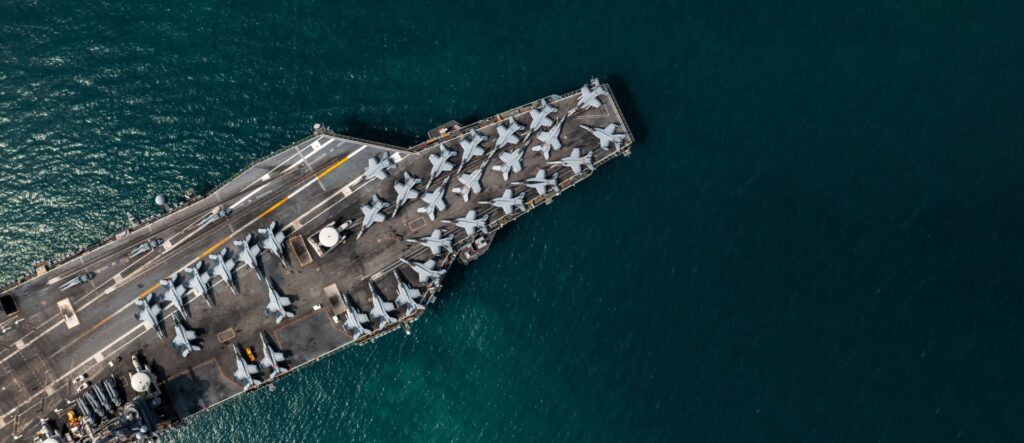
The most recognizable example of this type of system is found on aircraft carriers. There, fighter jets land on an extremely short runway and are brought to a stop by arresting cables that absorb the aircraft’s energy over a very short distance.
On the ground, the principle is similar, although adapted to different types of infrastructure and operations. The system must be capable of intervening when an aircraft needs external assistance to come to a stop within very specific safety parameters.
“It’s very similar to the system used on aircraft carriers. Both stop aircraft by absorbing energy, although aircraft carriers use arresting cables designed specifically for naval fighters.”, explains Abilio.
For land-based runways, these solutions are designed based on the type of aircraft, the airport environment, the available space, and the operational conditions of each facility.
A common solution in the defense sector, but also used at civilian airports
Brake barriers are primarily used at air bases and in military settings, especially for fighter jets. However, the concept also has applications at civilian or commercial airports.
At some airports, especially those constrained by their geographic surroundings or with less available runway end area, civil engineering solutions are used, such as EMAS (Engineered Materials Arresting System). It is a surface made of materials specifically designed to deform under the weight of an airplane.
Simply put: instead of providing rigid resistance, this area “gives way” in a controlled manner when the aircraft enters it, absorbing some of its energy and helping to stop it before it exceeds safety limits. According to the FAA (Federal Aviation Administration), the U.S. aviation authority, a standard EMAS must be capable of stopping the reference aircraft when it enters the system at 70 knots or less, approximately 130 km/h.
“It’s not used only in the military. It’s most commonly used for defense purposes, but there are also civilian solutions, such as EMAS systems, which are installed at the end of the runway to stop commercial aircraft.”, Abilio notes.
This type of solution is particularly relevant at airports where environmental conditions limit the available runway length or where it is necessary to increase the safety margins of operational safety.
Engineering that not all companies can afford
Designing an aircraft braking system involves more than simply selecting equipment and installing it at the end of a runway. It requires airport experience, aeronautical knowledge, structural and dynamic calculations, coordination with certified manufacturers and installers, and direct communication with the airport operator or the relevant authority.
The system must integrate seamlessly into the existing infrastructure, coexist with airport operations, and respond appropriately in an emergency. To achieve this, the forces at play are analyzed: the aircraft’s kinetic energy, braking force, system resistance, tension in cables or networks, material deformation, and the loads transmitted to anchors and foundations.
“In terms of project development and design, this solution requires airport experience, aeronautical knowledge, and expertise in structural and dynamic analysis,” Abilio points out.
Depending on the specific configuration, it may be necessary to dig side trenches alongside the runway to accommodate energy-absorption systems, design specific foundations, install special anchors, and ensure that all elements function properly alongside airport operations.
In addition, before being put into service, these systems must pass tests for structural strength, energy absorption, dynamic behavior, durability, corrosion, fatigue, operational performance, and maintenance. In certain cases, a real-world test may even be conducted using a specific aircraft to validate their performance.
The Viarium Experience: Albacete, Zaragoza, and Gran Canaria
Viarium is currently working on the design of an underground braking barrier at the Albacete Air Base. In addition, the company has previously participated in the design of braking solutions in Zaragoza and Gran Canaria.
This project highlights Viarium’s involvement in a highly specialized field of airport engineering, where operational safety, infrastructure design, aeronautical expertise, and coordination with relevant agencies all come together.
In this type of project, the value of engineering lies not only in defining a technically viable solution, but also in understanding how it should be integrated into a critical infrastructure, what operational constraints exist, and what level of reliability it must provide once it becomes operational.
The Last Line of Defense
Aircraft braking systems are rarely part of the public conversation about aviation safety. However, when an aircraft cannot come to a stop on the runway, how well its brakes work can mean the difference between running off the runway and coming to a controlled stop.
Their importance lies precisely in that: remaining nearly invisible during normal operations and acting with precision when there is no longer any room for maneuver.

